
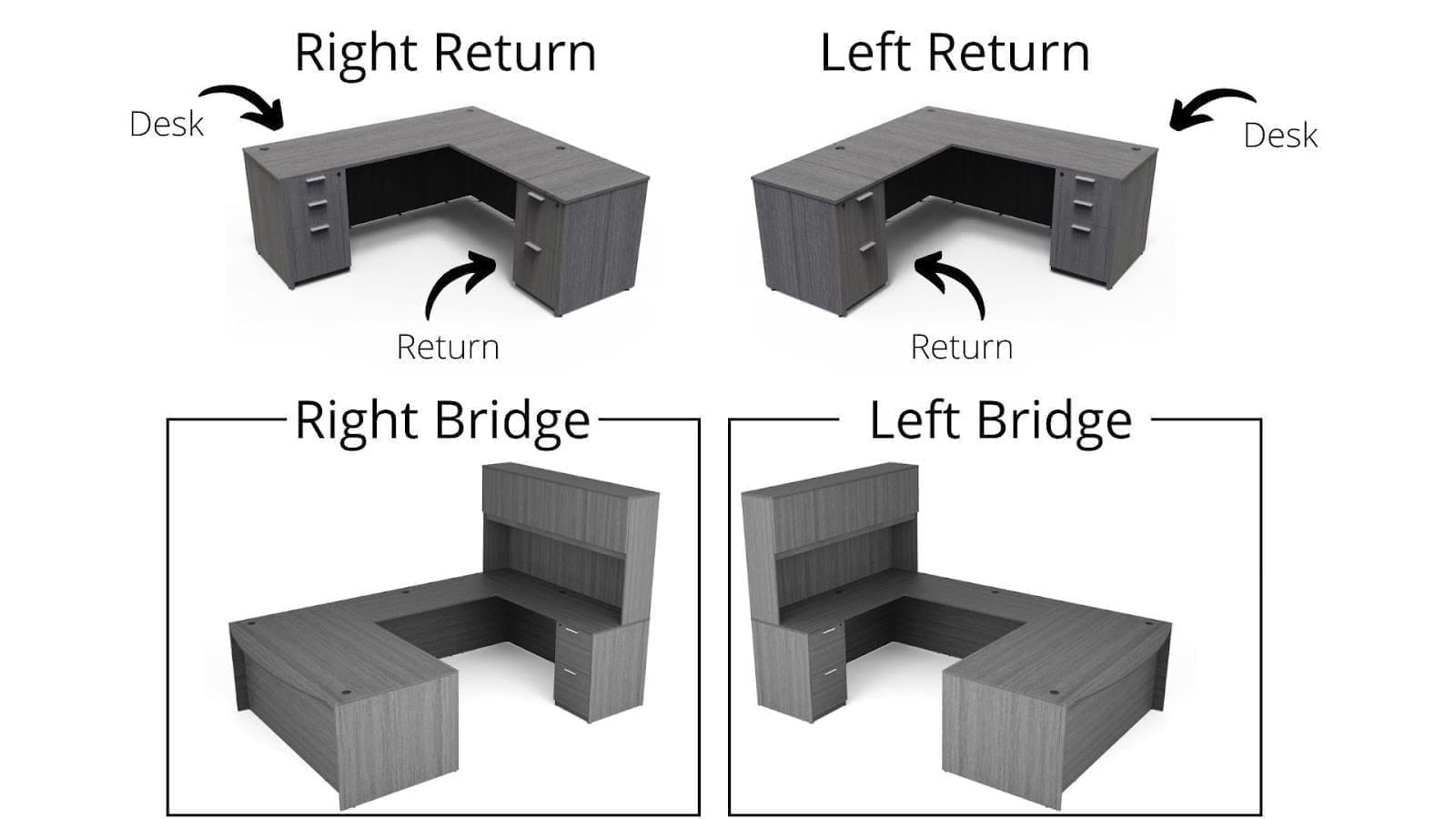
The three main office desk styles are the straight desk, the L-desk, and the U-desk. A straight desk is one work surface. An L-desk adds a return along one side. A U-desk adds a bridge and a credenza, creating three connected surfaces.
The part that trips people up is orientation. Order an L-desk or U-desk in the wrong direction, and it will not work in your room. Here is how to get it right.
Quick reference
| Desk style | Surfaces | Typical footprint | Best for |
|---|---|---|---|
| Straight desk | 1 | 48 to 72 inches wide | Small offices, open plans, shared space |
| L-desk | 2 | About 6×6 to 7×7 feet | Most private offices, managers |
| U-desk | 3 | About 8×8 to 10×10 feet | Executives, heavy paperwork |
What is a desk return?
A desk return is a secondary work surface that attaches to a main desk and depends on it for support. It has one open end so your legs fit underneath, and it turns a single desk into an L shape.
Returns come in left and right versions. They are not interchangeable.
How to tell which one you need: sit at the main desk. If the return extends to your left, that is a left return. To your right, a right return.
Returns are typically 24 inches deep, compared with 30 or 36 inches for the main desk. That difference is deliberate. It keeps the return from eating the walking space in a small office.
Left return or right return? The rule that settles it
Put the desk facing the door. Put the return on the wall opposite the door.
That is the whole rule, and it solves most office layouts.
Why it works. You end up facing anyone who walks in, which is what most people want. The return sits against a wall instead of blocking the path. You get a clear walkway from the door to your chair. And there is room for guest seating in front of the desk instead of behind a surface.
Walk through it. Your office door sits in the top left corner. Your desk faces the door. The wall opposite the door is on your right as you sit. You need a right return.
Get it backward, and the return cuts across the entry. You squeeze past your own furniture, guests have nowhere to sit, and the room feels half its size.
When to break the rule: a window you want to face, a wall of built-in storage, or a corner column can all override it. The rule is a starting point, not a law.
The three desk styles
Straight desk
One rectangular surface, usually 48 to 72 inches wide and 30 or 36 inches deep. It can take one or two pedestals underneath.
Best for: small offices, open plans, shared desks, and anyone who works mostly on a laptop.
Watch out for: running out of surface fast if you use dual monitors and paper at the same time.
L-desk
A straight desk plus a return. Two connected surfaces at a right angle.
Best for: most private offices. It is the practical default. You get monitors and a keyboard on the main surface and paper, a printer, or a second screen on the return.
Watch out for: ordering the wrong orientation. This is the single most common mistake we see on furniture projects.
U-desk
A straight desk, a bridge, and a credenza. Three connected surfaces that wrap around you.
The bridge is the piece connecting the desk to the credenza. The credenza is the surface behind you, usually 24 inches deep, and it often carries an overhead hutch.
The bridge sets whether a U-desk is left- or right-handed, and the same door rule applies.
Best for: executive offices, anyone handling a lot of paper, and anyone who wants a clear surface in front of guests and a working surface behind them.
Watch out for: size. A U-desk needs real square footage and to fit through your door and elevator. Measure the path, not just the room.
Sit-to-stand desk
Worth adding to the list. A height-adjustable surface, available as a straight desk or an L configuration.
Best for: anyone who sits more than 6 hours a day.
Watch out for: cable management. A desk that moves needs cables that move with it. Budget for a cable tray.
Pedestals: the drawers under your desk
A pedestal is the drawer unit that sits under a desk or work surface. In this industry, "ped" is short for pedestal. It has nothing to do with a platform you stand on.
Two drawer sizes make up almost every configuration:
Box drawer. About 6 inches tall. Pens, supplies, small items. Sometimes called a pencil drawer. File drawer. About 12 inches tall. Hanging files.
Those combine into three standard pedestals:
| Pedestal | Drawers | Best for |
|---|---|---|
| BBF (box/box/file) | 2 box + 1 file | Most people. Supplies plus some filing. |
| FF (file/file) | 2 file | Heavy paper users: legal, accounting, HR |
| BF (box/file) | 1 box + 1 file | Compact spaces and shorter surfaces |
The classic setup is one BBF and one FF in a straight desk.
What we see more of now: two BBF pedestals. Most offices file less paper than they did ten years ago, and people would rather have space for supplies than a second file drawer. Think about your actual paper volume, not the volume you had in 2015.
Mobile pedestals are a fourth option. They roll, so they move where you need them and tuck away when you do not. Good for desks people share or book by the day.
Measure before you order
Five measurements save most projects.
1. The room. Wall to wall, both directions. Note the door swing, windows, columns, and outlets.
2. The door. Width and height, including the frame.
3. The path. Hallways, corners, and the elevator. A desk that fits the room but not the elevator is still a problem.
4. The clearance behind the desk. You need at least 36 inches to push a chair back and stand up. Forty-eight is better.
5. The walkway. Draw the line from the door to your chair. If it crosses the desk, rotate something.
Get a free 3D drawing before you buy
Every mistake above disappears when you first see the room drawn.
We create a free 3D drawing of your office using real products at your actual dimensions. You see the orientation, the clearances, and the walkways before anything ships. Change it as many times as you want.
That drawing is the reason we do not get many "the return is on the wrong side" phone calls.
Visit us at 1517 Alum Industrial Dr N, Columbus, OH 43209. Weekdays 9 to 5. Call (614) 332-1828.
Frequently asked questions
What is a desk return? A desk return is a secondary work surface that attaches to a main desk and relies on it for support. It has one open end so your legs fit underneath, and it turns a straight desk into an L shape. Returns are typically 24 inches deep, compared with 30 or 36 inches for the main desk.
What is the difference between a left return and a right return desk? Sit at the main desk. If the return extends to your left, it is a left return. If it extends to your right, it is a right return. The two are not interchangeable, so getting the orientation right before you order matters.
Should I get a left- or right-return desk? Face the desk toward the door and put the return on the wall opposite the door. That keeps the walkway clear, leaves room for guest seating, and lets you see anyone who walks in. Windows, built-in storage, or columns can override the rule.
What is the difference between an L-desk and a U-desk? An L-desk is a straight desk plus a return, giving you two connected surfaces. A U-desk adds a bridge and a credenza for three connected surfaces that wrap around you. U-desks need considerably more floor space.
What does BBF mean in office furniture? BBF stands for box/box/file. It describes a pedestal with two shallow box drawers, each about 6 inches tall, above one deeper file drawer, about 12 inches tall. FF means file/file, and BF means box/file.
What is a pedestal on a desk? A pedestal is the drawer unit that sits under a desk or work surface. The industry shortens it to "ped." A pedestal either bolts to the desk or rolls on casters.
What is a bridge on a U-desk? The bridge is the surface that connects the main desk to the credenza on a U-shaped desk. Which side the bridge sits on determines whether the U-desk is left-handed or right-handed.
How much space do I need behind my desk? Allow at least 36 inches between the back of the desk and the wall so you can push your chair back and stand. Forty-eight inches is more comfortable, especially if anyone walks behind you.
Have a question this did not answer?
Call 614.332.1828 and ask a person. We have been doing this for twenty years and we will give you a straight answer.