
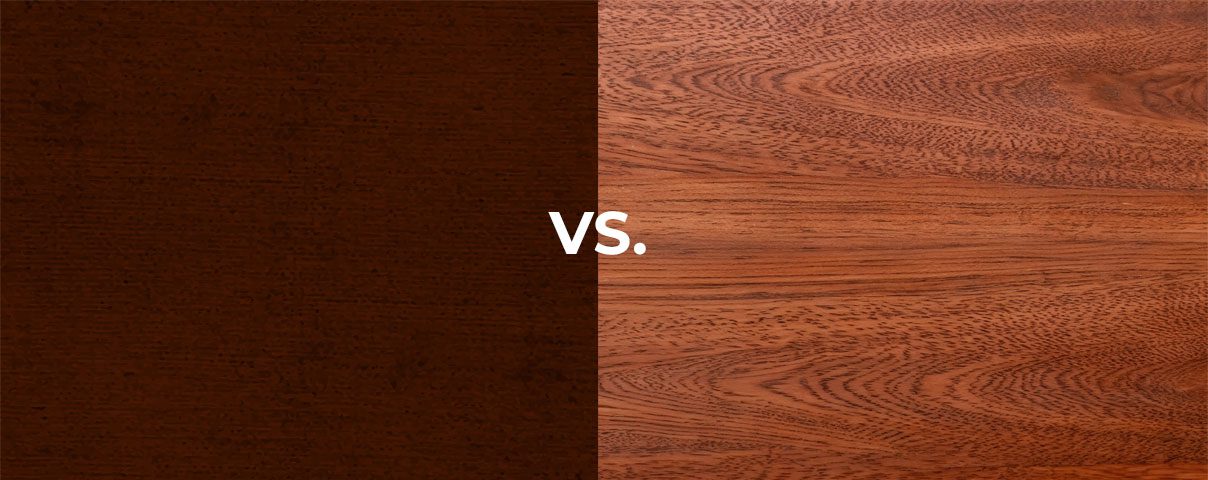
Cherry and mahogany look similar, but they are not the same wood. Cherry grows in North America, starts out pinkish-brown, and darkens to a deep reddish-brown over a few years. Mahogany grows in the tropics, starts reddish brown, and shifts more slowly. Cherry rates 950 on the Janka hardness scale. Genuine mahogany rates 900. Cherry costs less and ships faster. Mahogany carries international trade restrictions.
Here is everything else you need before you spend money.
Quick comparison
| Cherry | Genuine Mahogany | |
| Scientific name | Prunus serotina | Swietenia macrophylla |
| Where it grows | Eastern North America | Central and South America |
| Janka hardness | 950 lbf | 900 lbf |
| Fresh color | Light pinkish brown | Pale pink to reddish brown |
| Aged color | Medium to deep reddish brown | Deeper reddish brown |
| Grain | Usually straight, fine, even | Straight, interlocked, or wavy |
| Signature look | Rich patina with age | Ribbon stripe on quartered cuts |
| Trade status | No restrictions. IUCN Least Concern | CITES Appendix II. IUCN Endangered |
| Typical cost | Lower | Higher |
Sources: The Wood Database, CITES, IUCN Red List.
How to tell them apart
Color
Fresh cherry looks light. Almost pink. People see it in a showroom and think it looks pale. Then it darkens. Sunlight speeds this up. Within a year or two, cherry deepens into a warm reddish brown that most people love.
This surprises buyers more than anything else about cherry. If you match a new cherry desk to a ten-year-old cherry credenza, they will not match today. Give the new piece time.
Mahogany starts closer to its final color. It darkens too, but the change is smaller.
Grain
Cherry grain runs mostly straight. The texture is fine and even. You get a soft, quiet look.
Mahogany grain does more. It can run straight, but it also interlocks and waves. Cut a mahogany board on the quarter, and you often see ribbon stripe, a pattern where light and dark bands flip as you walk past. Flatsawn mahogany can show ripple marks.
Mahogany also shows chatoyancy. That is the shimmer you see when the surface seems to shift as you move. Cherry rarely does this.
Hardness
Cherry: 950 pounds of force on the Janka scale. Genuine mahogany: 900 pounds of force.
Both rate as soft hardwoods. Neither one shrugs off a dropped stapler. If you want dent resistance above everything, look at sapele at about 1,360 or hard maple at 1,450 instead.
The mahogany problem nobody tells you about
Plenty of sellers label wood “mahogany” when it is not genuine mahogany.
Genuine mahogany means Swietenia macrophylla. CITES lists it in Appendix II. The IUCN lists it as Endangered. Wild populations dropped more than 60 percent over the past 180 years. Legal genuine mahogany exists, and plantation stock is growing, but it costs real money and comes with paperwork.
So the industry sells other woods under the mahogany name:
African mahogany (Khaya species). Close cousin. Janka 850. CITES added all African populations of Khaya to Appendix II on February 23, 2023. That listing covers logs, sawn wood, veneer, plywood, and transformed wood. If a dealer quotes you African mahogany today, ask about documentation.
Sapele. Janka: about 1,360. Harder than both cherry and genuine mahogany. Shows beautiful ribbon stripe. Often the smartest choice when you want the mahogany look and better durability.
Philippine mahogany, or lauan. Not a mahogany at all. Different family entirely. Softer, cheaper, and common in low-cost imports.
“Mahogany finish.” This is not wood. It is a stain color. A mahogany finish can be applied over maple, birch, poplar, or particleboard.
Ask one question when you shop: is this the species or the stain? A good dealer answers straight. So do we.
Should you buy solid wood or veneer?
Buy the veneer. Seriously.
Most people assume solid wood beats veneer every time. On a desktop, that is backward.
A wide solid panel moves as humidity changes. Columbus swings from humid summers to dry winters. That movement cups, cracks, and splits large solid tops over time. A veneered panel bonds a thin layer of real cherry or mahogany over a stable core. The core does not move much. The top stays flat.
Veneer also lets you use figured wood that would be too expensive or too unstable in solid form.
Where solid wood wins: edges, legs, drawer fronts, and anything that takes impact. A solid edge survives a chair bump. A thin veneer edge chips.
The best desks use both. Veneered tops. Solid edges and legs.
Wood terms your salesperson will use
Mottle. A blotchy, uneven shimmer in the grain. It is a figure pattern, not a defect.
Fiddleback. Wavy bands running across the grain that look like flames. Violin makers prize it. It shows up in maple, mahogany, sapele, and other species. It is not a maple-only trait.
Blister. A rounded, bubble-like figure in the wood. Do not confuse it with a delaminating veneer, which is a real defect in which the glue fails and the surface lifts.
Chatoyancy. The shimmer that shifts as you change your viewing angle.
Quartersawn. A cut that runs across the growth rings. It produces straighter grain and more stable boards. Quartersawn mahogany is where ribbon stripe comes from.
Flatsawn. The most common cut. Produces the cathedral arch pattern most people picture when they think of wood grain.
Which one should you pick?
Pick cherry if:
- You want a warm, traditional look that gets better with age
- You want domestic wood with no trade paperwork
- You want the lower price
- You are matching existing cherry and can wait for the color to catch up
Pick genuine mahogany if:
- You want the deepest luxury look for an executive office or boardroom
- Ribbon stripe matters to you
- The budget supports it, and the documentation checks out
Pick sapele if:
- You want the mahogany look with more dent resistance
- You want figure without the endangered-species paperwork
Pick a mahogany or cherry finish on another wood if:
- Budget drives the decision
- The look matters more than the material
None of these is wrong. They are different tradeoffs.
Matching wood across an office
Two rules save most projects.
One, match within a room. Coordinate across rooms. Every desk in the boardroom should match. The boardroom and the lobby only need to work together.
Two, buy your matched pieces at the same time. Wood color varies by tree, by cut, and by production run. Two identical cherry desks ordered a year apart will not look identical.
If you already own cherry and need to add to it, bring us a drawer front or a photo in natural light. We match against real inventory rather than guessing from a catalog swatch.
See it in person
Photos lie about wood. Screens shift color, and no photo shows you chatoyancy or how a finish handles a room’s light.
Come see it. Our showroom sits at 1517 Alum Industrial Dr N in Columbus, just east of downtown off Alum Creek Drive. We are open weekdays from 9 to 5.
Browse new office desks, used office desks, or our product finishes to start narrowing things down. Then call us at (614) 332-1828, and we will walk you through it.
Frequently asked questions
Is cherry or mahogany more expensive? Genuine mahogany costs more than cherry in almost every case. Cherry grows in North America, so it carries no import cost and no CITES paperwork. Genuine mahogany is CITES Appendix II listed and travels a long way.
Is mahogany harder than cherry? No. Cherry rates 950 lbf on the Janka hardness scale. Genuine mahogany rates 900 lbf. Cherry is slightly harder. Both are softer than sapele at about 1,360 lbf, or harder than maple at 1,450 lbf.
Does cherry wood darken over time? Yes. Cherry starts light pinkish-brown and darkens to a medium or deep reddish-brown as it ages and takes on light. Most of the change happens in the first six to twelve months. Sunlight speeds it up.
Can you stain cherry to look like mahogany? Yes, and manufacturers do it constantly. A “mahogany finish” describes a stain color, not a species. Always ask whether a quote refers to the wood or the finish.
What is the difference between genuine mahogany and African mahogany? Genuine mahogany is Swietenia macrophylla from Central and South America, rated 900 lbf. African mahogany is Khaya species from Africa, rated 850 lbf. They are related but different. CITES added all African populations of Khaya to Appendix II on February 23, 2023.
Should I buy a solid wood desk or a veneered one? For the desktop, veneer usually performs better. A wide solid panel expands and contracts with humidity and can cup or crack over time. A veneered top over a stable core stays flat. Solid wood is the better choice for edges, legs, and drawer fronts.
What is ribbon stripe mahogany? Ribbon stripe is a figure pattern in which alternating light and dark bands appear to flip as you change the viewing angle. It comes from quartersawing wood with interlocked grain. Mahogany and sapele show it well.